


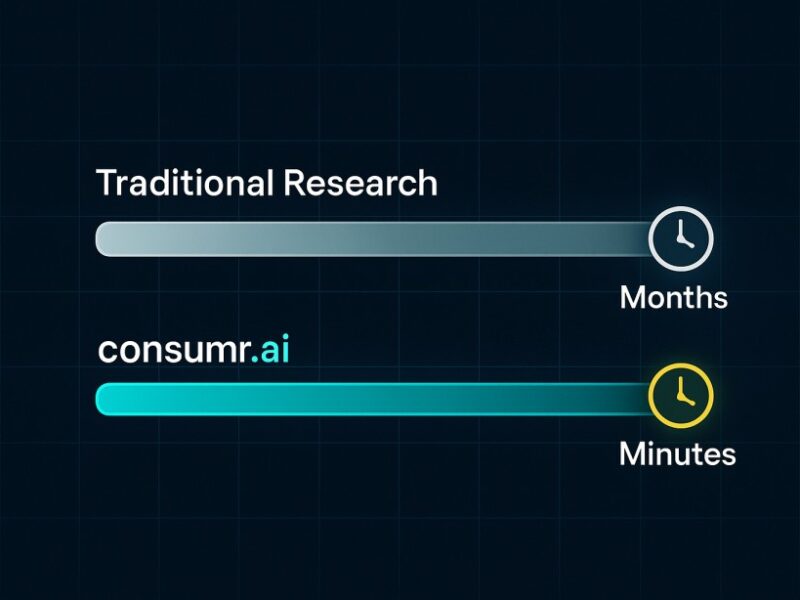
For decades, the world’s largest brands have relied on traditional market research giants like NielsenIQ, Kantar, Ipsos, GfK, and McKinsey to decode consumer behaviour. These firms built their reputations on vast data panels, syndicated studies, and human-led qualitative research—offering depth, global reach, and established credibility. Yet, in today’s fast-moving consumer landscape, weeks-long timelines and expensive custom studies often struggle to keep pace with real-time decision-making. This is where consumr.ai positions itself differently. Instead of relying solely on panels that are restricted by scale or consultants that has experience bias, consumr.ai brings together AI-driven consumer “Twins,” instant creative evaluation, and campaign optimisation in one SaaS platform—delivering intelligence in hours, not weeks. The comparison below explores how this AI driven product stacks up against these legacy players across pricing, speed, capabilities, and integration.
| Feature/Criteria | consumr.ai (AI driven SaaS) | NielsenIQ | Kantar | Ipsos | GfK | McKinsey (Consumer Insights) | |
|---|---|---|---|---|---|---|---|
|
Pricing Model |
✔️ Subscription – Starts from $1,000/month |
❌ Custom/ Enterprise – Typically subscription fees for data services or large project-based fees (costs often very high; pricing not publicly standardized) |
❌ Custom – Mix of project fees and syndicated study subscriptions (cost varies per study, generally enterprise-level pricing) |
❌ Custom – Project-based pricing for studies or trackers (no fixed rate; priced per research scope) |
❌ Custom – Data license fees for panels/reports or custom research project costs (negotiated per client need) |
❌ Custom Consulting – Engagement-based fees (no product pricing; consulting projects can run into hundreds of thousands) |
|
|
Real-Time Insights |
✔️ Yes – True real-time insights (immediate AI-generated answers; no waiting for data collection) |
✔️ Partial – Some data on demand via NIQ Discover platform (integrated consumer+retail data with on-demand queries; underlying data updated periodically, e.g. weeklyppc.land) |
❌ No – Most outputs delivered in days or weeks (even Kantar’s “automated” tools return fast results in minutes or hours in best cases, but not instant live insight) |
❌ No – Standard research studies take time (though Ipsos offers faster services, results are not instantaneous)
|
❌ No – Reports and data are delivered on scheduled intervals (no immediate query of new data in real time) |
❌ No – Insights are gathered and analyzed over weeks/months as part of consulting (no continuous real-time feed) |
|
|
Access to Consumer Cohorts (Respondent Pool) |
✔️ Yes – Uses AI Twins to emulate consumer cohorts (draws on vast observed determinisitic data so you can target any demographic virtually at a cohort level) |
✔️ Yes – Global consumer panels (e.g. NielsenIQ Homescan) tracking purchases/behaviorsnielseniq.com; clients get data from these panels (for surveys, Nielsen often partners or uses these panels) |
✔️ Yes – Maintains large panels & networks in many countries (Kantar Profiles for online sampling, offline recruitment capabilities; can reach diverse consumer groups for surveys or tests) |
✔️ Yes – Owns and operates panels (e.g. KnowledgePanel in U.S.) and global sample sources; fieldwork capabilities in 90+ markets to access virtually any target group |
✔️ Yes – Has panels and data assets especially in retail, tech, and media (e.g., GfK has consumer panels for tech products, purchase panels, etc., plus access to global sample providers) |
❌ No – No permanent respondent panel (McKinsey commissions surveys or uses third-party data sources during projects as needed, rather than maintaining its own standing panel of consumers) |
|
|
Qualitative Insights (Focus Groups & Depth) |
✔️ Yes – Simulated qual via AI (platform conducts instant focus group-like discussions and investigative Q&As with AI personas, yielding transcripts and sentiment analysis) |
❌ Limited – Primarily quantitative data focus (NielsenIQ’s strength is in sales and survey data; any qualitative insights typically come from small panels or Nielsen’s qualitative units, which are not core services) |
✔️ Yes – Offers full-service qualitative research (traditional focus groups, in-depth interviews, ethnographies through its qualitative division and specialist teams – though results take time and human analysis)
|
✔️ Yes – Strong qualitative research offerings (Ipsos UU – “Understanding Unlimited” – specializes in focus groups, ethnography, online communities, etc., executed by human moderators; not software-based but a service) |
✔️ Limited – Can conduct qual research if requested (historically more quant-focused; GfK does some qualitative or uses partner agencies, but it’s not a flagship service for them) |
❌ Limited – Does not offer qualitative research as a product (consultants may do expert interviews or consumer interviews within a project, but no focus group facilitation service akin to research agencies) |
|
|
Meeting Modes (Workshops/Group Sessions)
|
✔️ Yes – Virtual AI meetings (Focus Group mode with AI consumer personas discussing, Brainstorm mode for idea generation, etc., all automated) |
❌ No – Does not provide interactive meeting formats (NielsenIQ delivers data via dashboards/reports, not live discussion sessions) |
❌ No – No software for this (any “meeting” would be a physical/Zoom focus group arranged by Kantar staff, not an on-demand feature; Kantar’s insights are delivered as reports or presentations) |
❌ No – No on-demand meeting tool (qualitative sessions are scheduled and moderated by Ipsos researchers when needed, not a built-in client tool) |
❌ No – Not available (GfK’s deliverables are datasets and analysis, not real-time meeting simulations) |
❌ No – Not applicable (McKinsey might run client workshops, but there’s no consumer meeting product; all insights come through consulting analysis) |
|
|
Creative Evaluation (Ad & Concept Testing) |
✔️ Yes – AI-powered creative testing (upload ads or concepts and get automated feedback from AI Twins; platform even suggests improved creative versions) |
✔️ Yes – Extensive ad & product testing solutions (e.g. Nielsen BASES for concept testing and forecasting, Nielsen Ad Effectiveness studies for ads). Typically involve surveying real consumers and normative databases; results are project-based, not instantaneous |
✔️ Yes – Best-in-class creative testing (e.g. Kantar LINK, an ad testing suite with normative benchmarks; now also Link AI which uses AI to predict ad performance in ~15 minuteskantar.com, giving fast feedback backed by Kantar’s database) |
✔️ Yes – Broad creative testing offerings (Ipsos has specialized products like Ipsos ASI for advertising pre-testing, and automated tools like Creative |
Spark for quick ad feedback; uses large normative data for comparison) |
✔️ Limited – Provides concept and ad tests mainly in certain sectors (GfK can test product concepts or ads, often focusing on tech or consumer goods, using surveys or labs. Not as widely advertised as Nielsen/Kantar; may partner for some tests) |
|
|
AI Twin Interactions (Simulated Consumers)
|
✔️ Yes – Unique AI Twin approach (digital consumer avatars created from data, used for direct Q&A and scenario testing to predict consumer responses) |
❌ No – Relies on actual consumer data (no AI-simulated personas; NielsenIQ’s innovation is in data integration and analytics, not creating virtual consumers) |
❌ No – Uses real respondents and analysts (no concept of AI-driven consumer simulation in research process) |
❌ No – No (insights come from real survey/focus group participants or observational data; no AI consumer personas) |
❌ No – No (GfK’s insights are from real-world data panels and surveys; AI used in modeling but not as pseudo-respondents) |
❌ No – Not at all (McKinsey provides expert analysis and perhaps advanced analytics, but does not have AI personas for consumers) |
|
|
AI Co-Pilots/Analytics (Intelligence Support) |
✔️ Yes – AI co-pilots assist at every step (from auto-generating smart questions to deconstructing complex problems via AI agents, to summarizing findings and suggesting actions) |
✔️ Emerging – Introducing AI-driven analysis: e.g. NIQ Ask Arthur, a GenAI tool in NielsenIQ’s platform to query data in natural language and get insightsppc.land. (Enhances data analysis, but not an interactive research designer like consumr’s AI) |
✔️ Partial – Leveraging AI in specific areas (Kantar uses AI for faster analysis, e.g. Link AI for ad testing predictions, and other analytics in brand tracking; however, human researchers still heavily involved for custom insights) |
✔️ Partial – Employs AI and machine learning for data processing (e.g. Ipsos uses AI for social media monitoring, text analytics, etc., to support its researchers). No general AI assistant for clients, but AI is used under the hood in some Ipsos solutions
|
✔️ Partial – Uses advanced analytics/AI for things like forecasting, segmentation, and data integration (for example, GfK’s algorithms for market prediction). However, clients don’t directly interact with an AI assistant; the AI is in the background of GfK’s tools |
❌ No – Insights are analyst-driven (McKinsey may use sophisticated analytical models and even AI internally for data crunching, but the client-facing delivery is expert consultation, not an AI tool or assistant provided to clients) |
|
|
Campaign Planning/Optimization |
✔️ Yes – Integrates with marketing execution: consumr.ai not only provides insights but can tie into campaign tools (e.g. guiding Google Ads or social campaigns by suggesting target tweaks based on AI Twin feedback) for ongoing optimization |
✔️ Yes – Offers marketing effectiveness consulting and tools (NielsenIQ provides Marketing Mix Modeling and sales lift analytics to optimize media spend and product placement; also brand lift studies for campaign impact – though delivered as analyses, not self-serve software) |
✔️ Yes – Provides data and advisory for campaign optimization (Kantar’s analytics teams run cross-media effectiveness studies, brand lift tests, and advise on media plans; Kantar data (media consumption, brand equity) helps optimize channel and creative mix, typically via reports) |
✔️ Yes – Measures and advises on campaign performance (e.g. Ipsos conducts campaign lift studies for digital and TV, tracking brand impact, and offers guidance on improving messaging or targeting as a result; also can do marketing mix modeling through Ipsos MMA unit) |
✔️ Yes – Offers marketing and media effectiveness insights (GfK’s data – especially in retail and tech – helps optimize marketing and channel strategy; GfK’s Market Intelligence and consumer trends can inform campaigns. They also have consulting for marketing ROI in some regions) |
✔️ Yes – Strategic optimization focus (McKinsey’s Consumer Insights/Marketing experts help clients redesign marketing strategy, media allocations, and customer targeting to maximize ROI as part of consulting projects. They use data-driven models to recommend optimal campaign mixes) |
|
|
Channel Mix Analysis (Omni-channel)
|
✔️ Yes – Analyzes multi-channel consumer engagement (AI Twins can be queried on behaviors in various channels; platform helps identify which channels (social, search, retail, etc.) resonate best and how to allocate efforts) |
✔️ Partial – Omni-channel data: NielsenIQ (with Nielsen) covers many channels – e.g. retail, e-commerce, and media (via Nielsen media ratings). Clients can analyze cross-channel reach and sales, but usually through separate Nielsen services and expert analysis, not a unified DIY tool |
✔️ Yes – Cross-media and omni-channel insights offered (Kantar’s data spans TV, digital, print, purchase, etc. They conduct CrossMedia studies to measure holistic campaign reach and have consumer panels tracking online/offline behavior. Insights are delivered via dashboards or reports to guide channel mix) |
✔️ Yes – Holistic view via studies (Ipsos can combine survey, social listening, and third-party data to evaluate multi-channel impact; e.g. unified campaign evaluation across Facebook/TV/OOH. It’s delivered as research findings to optimize channel mix, rather than an automated tool) |
✔️ Partial – Multi-channel market data available (GfK tracks online vs offline sales in many industries and runs studies on media consumption like GfK MRI for print/TV/digital in some markets. These data allow channel planning analysis, but clients must analyze or use GfK’s consulting to interpret for mix decisions) |
✔️ Yes – Comprehensive cross-channel perspective (McKinsey’s approach looks at all consumer touchpoints; through its Marketing & Sales practice, it uses data from multiple channels (often client’s own plus market data) to identify which channels drive growth and advises on optimal channel mix in strategy recommendations) |
|
|
Integrations (Enterprise Data Systems) |
✔️ Yes – Built for integration: connects with ad platforms, social media, and e-commerce APIs to pull consumer signals; also allows uploading internal data to inform the AI (high interoperability). Can push insights or campaign tweaks back into marketing tools (e.g. activate a campaign directly on Google via consumr.ai) |
✔️ Partial – NielsenIQ’s new cloud platform NIQ Discover integrates its own data streams (retail + panel) for clientsppc.landppc.land. Nielsen also delivers data to clients via APIs/data feeds (e.g. retail scanner data into clients’ analytics systems). Integration is mostly about Nielsen data merging with client data rather than connecting many third-party apps |
✔️ Partial – Kantar provides data portals and some APIs for large clients (for example, data from Kantar’s BrandZ or Worldpanel can be fed to client systems). However, much of Kantar’s integration is manual – delivering datasets that clients integrate on their end. Not a plug-and-play app integration with marketing platforms |
✔️ Partial – Ipsos offers dashboards for ongoing studies and can deliver data in formats for client databases. They don’t have out-of-the-box integrations with CRMs or marketing tools; instead, Ipsos teams often help clients incorporate survey data into the client’s own systems as needed (case-by-case) |
✔️ Partial – GfK has certain products with API access (for example, GfK point-of-sale data or consumer insights can be accessed via API by subscribers in some cases). Generally, GfK provides data via its software (like GfK Neuron) or file transfer; integration with other enterprise systems typically requires custom solutions
|
❌ No – As a consulting service, McKinsey doesn’t offer software to integrate. They work with whatever data the client provides (CRM, ERP, etc.) internally during a project and might build custom tools for a client, but there’s no ongoing data integration platform offered to clients by McKinsey’s Consumer Insights practice |
|
|
API & Data Interoperability |
✔️ Yes – Open API available for programmatic access to the platform’s capabilities and data; also highly interoperable with external data: users can import their own files/URLs as data sources to enrich analyses (making consumr.ai a very flexible intelligence hub)
|
✔️ Partial – NielsenIQ provides data via APIs in certain cases (big clients can get continuous data feeds of scanner or panel data into their systems). However, clients cannot generally upload arbitrary external data into Nielsen’s tools – the data flows are mostly Nielsen -> client. Interoperability is improving (e.g., Nielsen’s connected ecosystem for retail and consumer data) but it’s not open in the way a SaaS platform is |
❌ No – No general public API for pulling Kantar data; data interoperability is limited. Clients get access through Kantar’s interfaces or receive raw data files. You can of course merge Kantar’s delivered data with your own internal data manually, but Kantar’s platforms don’t directly ingest client data inputs in self-serve fashion |
❌ No – Ipsos does not offer an API for external developers. They deliver data/reports which clients can use internally, but their platforms (like Ipsos.Digital) are mostly for ordering studies, not for integrating client datasets. Any blending of Ipsos findings with other data happens outside the Ipsos system by the client |
✔️ Partial – GfK has started to provide APIs for certain digital data products, but it’s not universal. Interoperability is moderate: for instance, GfK can ingest retailer sales data in their models or deliver data to client warehouses. Still, much of GfK’s insight generation is self-contained within their tools, not accepting arbitrary external data from clients in real time |
❌ No – Not applicable (McKinsey’s work is project-based; no ongoing platform or API. Any data integration is done by McKinsey analysts during the engagement, using client’s data alongside external research, rather than through a client-facing API or software) |
|
Traditional market research firms continue to play a critical role in providing depth, scale, and trusted methodologies that enterprises have relied on for decades. However, their models are built around syndicated data releases, extensive fieldwork, and consulting-heavy engagements—making them powerful but often slow and costly. consumr.ai bridges that gap by combining the intelligence of AI Twins with always-on creative testing, campaign optimisation, and real-time consumer simulations. The result is a platform that delivers actionable insights in hours instead of weeks, at a fraction of the cost. For businesses in the U.S. and Canada looking to balance the credibility of legacy research with the speed and flexibility of SaaS, consumr.ai represents a new standard: fast, scalable, and built for the realities of modern marketing.

consumr.ai is a consumer intelligence platform that analyses behavioral data from tik tok, meta, google, snapchat and pinterest to tell you what your audience thinks, searches, buys and content they consume. Unlock the power of first party intelligence strengthened by real time behavioral signals from digital marketing platforms.
consumr.ai is a consumer intelligence platform that analyses behavioral data from tik tok, meta, google, snapchat and pinterest to tell you what your audience thinks, searches, buys and content they consume. Unlock the power of first party intelligence strengthened by real time behavioral signals from digital marketing platforms.